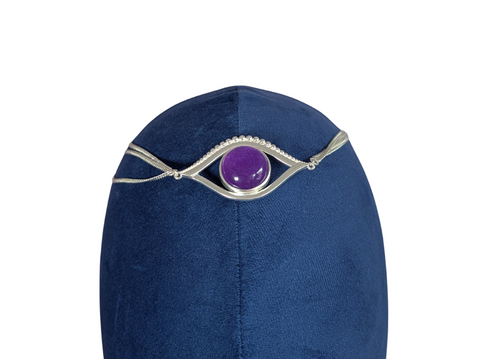
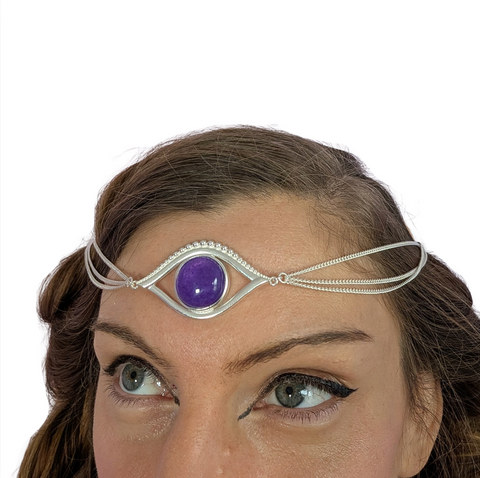
This wearable crown depicts a symbolic and activating image of your third eye. The amethyst entrains with the crystals inside your pineal gland to activate a sense of deep knowing, calm, and gratitude that makes higher awareness easy. The energy spirals through your entire being and you radiate harmony. Plus, you look super cool.
Sacred Geometry Meets Higher Consciousness
The elongated horn geometry creates a natural antenna effect, drawing cosmic and telluric energies into a concentrated beam that flows directly through your crown. This vertical alignment acts as a conduit between earthly and celestial realms, facilitating the kind of expanded awareness that ancient mystics spent lifetimes pursuing.
Amethyst - Amethyst's natural quartz oscillation creates a stable carrier frequency that entrains your brainwaves into meditative theta and alpha states. Its purple ray activates the crown and third eye simultaneously, bridging perception with divine consciousness.
When to Wear
Less intense than our other crown options, this simple design is accessible even to the beginner without overwhelming them. This crown can be worn for long periods of time and can help against negative cyclical thoughts, nightmares, and anxiety. Perfect for a sound bath or night out where you want to look and feel like the divine entity you are.
Note: This particular batch of crows came out a bit bigger than the others. They are adjustable but will fit larger heads easier. Perfect for a hat-band. If you're interested in this piece but have a smaller head, we can work together to figure out a modification. Just reach out.
Pyramidal Resonance Architecture and Consciousness Elevation
The Meditator employs a conical pyramidal geometry to create what electromagnetic engineers call a "waveguide structure" a three-dimensional antenna that concentrates and amplifies specific frequency ranges. This design principle, observed in ancient sacred architecture from Egyptian pyramids to Gothic spires, creates a natural acoustic-electromagnetic resonance chamber that interacts with the human biofield.
I. The Neuroscience of Meditation
Before exploring the device's enhancement mechanisms, it's essential to understand what occurs in the brain during deep meditative states:
Brainwave State Transitions Meditation induces a cascade of neurological changes measurable through electroencephalography (EEG):
Beta to Alpha Transition (13-30 Hz → 8-13 Hz): Within 5-10 minutes of meditation, the brain shifts from beta (active thinking) to alpha (relaxed alertness). This transition corresponds with increased activity in the anterior cingulate cortex, which regulates attention and emotional processing.
Theta Emergence (4-8 Hz): Deep meditators access theta states while remaining conscious—a phenomenon typically only seen during REM sleep or hypnagogic states. Theta waves are associated with memory consolidation, creativity, and access to subconscious material. fMRI studies show increased theta power correlates with activation of the hippocampus and medial prefrontal cortex.
Gamma Synchronization (40-100 Hz): Advanced practitioners show unusual gamma wave activity, particularly in the 40 Hz range. Gamma represents high-level information processing and is theorized to be the neural correlate of consciousness itself. Studies of Tibetan monks show gamma power 25 times higher than baseline during compassion meditation.
Default Mode Network Deactivation The Default Mode Network (DMN) comprised of the medial prefrontal cortex, posterior cingulate cortex, and angular gyrus is responsible for self-referential thinking, mind-wandering, and the sense of a separate self. Meditation progressively deactivates the DMN, measured through decreased functional connectivity in fMRI studies. This deactivation corresponds with reports of ego dissolution, unity consciousness, and mystical experiences.
Neuroplastic Changes Longitudinal studies using magnetic resonance imaging show meditation induces structural brain changes:
Increased gray matter density in the hippocampus (memory, learning)
Thickening of the prefrontal cortex (executive function, decision-making)
Decreased amygdala volume (fear response, stress reactivity)
Enhanced connectivity between brain regions, particularly interhemispheric corpus callosum fibers
II. Crystalline Enhancement Mechanisms
Moonstone (Orthoclase Feldspar - KAlSi₃O₈) Moonstone serves as the foundation frequency generator. Its layered internal structure creates what materials scientists call a "photonic crystal" a periodic optical nanostructure that affects the propagation of electromagnetic waves.
The potassium ions (K⁺) within moonstone's lattice are mobile charge carriers. When positioned near the scalp, these ions respond to the ionic currents generated by neural activity (action potentials are literally waves of sodium and potassium ions crossing neuronal membranes). This creates a biofeedback loop: your brain's electrical activity influences the moonstone's ionic distribution, which generates subtle electromagnetic fields that influence neural firing patterns.
Moonstone is deeply connected to lunar cycles. Its potassium content makes it responsive to gravitational tidal forces. The same gravitational influence that creates ocean tides affects the distribution of ions in biological fluids, including cerebrospinal fluid surrounding the brain. Moonstone amplifies this lunar resonance, potentially explaining why many meditators report deeper states during new and full moons.
Iolite (Cordierite - Mg₂Al₄Si₅O₁₈) The middle stone, iolite is a cyclosilicate mineral with a unique property called pleochroism—it appears different colors (violet-blue to light blue to yellowish-gray) depending on the angle of observation. This optical anisotropy reflects an underlying electromagnetic anisotropy: iolite conducts electromagnetic fields differently along different crystallographic axes.
When positioned at the third eye region, iolite's directional conductivity creates what physicists call a "polarization filter" for electromagnetic noise. The human head is constantly bombarded with electromagnetic pollution—WiFi routers, cell phones, electrical wiring, all operating in the megahertz to gigahertz range. These frequencies create what neurologists call "electromagnetic smog" that interferes with the brain's subtle electrical patterns.
Iolite's iron and magnesium content gives it paramagnetic properties, it's attracted to magnetic fields. The Earth's geomagnetic field (approximately 50 microteslas) passes through your body constantly. Iolite aligns with these field lines, creating a stable reference frame for neural activity. This is analogous to how ancient navigators used iolite as a "Viking compass"it reveals true direction by filtering out confusing information.
At a quantum level, iolite contains trace amounts of transitional metals that can hold electron spins in metastable states. Quantum biology researchers propose that such "quantum coherent" systems in biological contexts may enable non-local information processing, the physical substrate for intuitive knowing and psychic perception.
Amethyst (Silicon Dioxide with Iron - SiO₂:Fe³⁺) The apex crystal, amethyst occupies the most critical position—the crown chakra, which corresponds anatomically to the pineal gland and the vertex of the skull where the fontanel (soft spot) closed in infancy.
Amethyst's quartz matrix makes it strongly piezoelectric: mechanical pressure generates electrical voltage, and conversely, electrical fields cause mechanical deformation. The skull undergoes subtle shape changes with every heartbeat (cardiac pulse pressure), every breath (intracranial pressure fluctuations), and every craniosacral rhythm (the 6-12 cycles per minute movement of cerebrospinal fluid). These mechanical oscillations are converted by the amethyst into electrical signals in the kilohertz range.
More remarkably, quartz crystals can store and release photons—actual particles of light. Research in quantum optics has demonstrated that quartz can serve as a "quantum memory" for photonic information. Given that neurons communicate not just electrically but through ultra-weak photon emissions (biophotons at 10⁻¹⁷ watts, detectable only with photomultiplier tubes), the amethyst may function as both an amplifier and a coherent re-emitter of neuronal light signals.
The iron impurities (Fe³⁺) that create amethyst's purple color are paramagnetic centers that interact with the Earth's magnetic field. Studies using superconducting quantum interference devices (SQUIDs) have detected that the human brain produces magnetic fields of 10⁻¹³ teslas—a million times weaker than Earth's field but highly organized. The amethyst's iron content may couple these weak biomagnetic fields to the stronger geomagnetic field, effectively amplifying neural magnetic signals.
III. The Horn Geometry: Scalar Wave Generation
The conical horn shape is an optimal geometry for what electrical engineers call "impedance matching." When electromagnetic waves travel from one medium to another (e.g., from your biofield into air), most of the energy reflects back unless the transition is gradual. The horn creates a smooth impedance gradient, allowing electromagnetic energy to radiate efficiently from the crown chakra.
The horn geometry generates "scalar waves" longitudinal electromagnetic waves (as opposed to the transverse waves of conventional EM radiation). Scalar waves propagate through any medium without attenuation and carry information non-locally. Research by physicists like Konstantin Meyl suggests scalar waves might explain action-at-a-distance phenomena including certain psychic effects.
The vertical orientation creates a standing wave pattern between the crown of your head and the apex of the horn. At specific frequencies (determined by the horn's height and the dielectric properties of the crystals), constructive interference occurs—waves reinforce rather than cancel. This standing wave creates nodes of maximum field intensity that interact with the pineal gland's electromagnetic sensitivity.
IV. The Pineal Gland: The Physical Third Eye
Photoreceptive Properties Despite being buried deep in the brain away from external light, the pineal contains photoreceptor cells similar to those in the retina. In some reptiles and amphibians, the pineal has a literal "third eye" on top of the head. In mammals, including humans, these photoreceptors have internalized but remain functional. The pineal receives indirect light information via the retinohypothalamic tract, but some researchers propose it may also detect light through electromagnetic sensitivity, the physical basis of what mystics call the "inner light."
Calcite Microcrystals The pineal gland contains calcite crystals (CaCO₃) with piezoelectric properties. These microcrystals, ranging from 2-20 micrometers, are structurally organized in concentric layers like onions. When subjected to mechanical pressure or electromagnetic fields, they generate electrical signals. This is the physical mechanism by which magnetic fields and other environmental influences can directly affect pineal function.
Notably, pineal calcite crystals have the same rhombohedral structure as calcite crystals found in the inner ear's otolith organs, which detect gravitational acceleration and head position. This suggests the pineal may function as a "gravitational sensor" or may be sensitive to subtle variations in the Earth's geomagnetic field, potentially explaining why meditation experiences often involve sensations of movement, floating, or spatial disorientation.
Neurotransmitter Synthesis The pineal gland synthesizes several consciousness-altering compounds:
Melatonin: Regulates circadian rhythms and induces sleep. Melatonin production increases in darkness and during meditation (when the eyes are closed and visual cortex activity decreases). Higher melatonin correlates with increased theta and delta brainwave activity.
Pinoline: A beta-carboline alkaloid with monoamine oxidase inhibitor (MAOI) properties. MAOIs prevent the breakdown of neurotransmitters like serotonin and potentially endogenous DMT, prolonging their effects.
5-MeO-DMT: Trace amounts of this potent psychedelic tryptamine have been detected in pineal tissue of mammals. While controversial, researcher Rick Strassman proposed that endogenous DMT release may account for mystical experiences, near-death experiences, and deep meditative states. The pineal contains all necessary enzymes (INMT, AADC) for DMT synthesis.
V. Meditation Benefits: The Physiological Cascade
Autonomic Nervous System Regulation Meditation shifts autonomic balance from sympathetic (fight-or-flight) to parasympathetic (rest-and-digest) dominance. This is measurable through:
Decreased heart rate and blood pressure
Increased heart rate variability (HRV)—the beat-to-beat variation that indicates autonomic flexibility
Reduced cortisol (stress hormone) and increased DHEA (youth/vitality hormone)
Enhanced vagal tone (vagus nerve activity), which regulates inflammation throughout the body
Immune System Enhancement Studies show meditation increases:
Natural killer cell activity (cancer surveillance)
Immunoglobulin A levels (first-line immune defense)
Telomerase activity (the enzyme that maintains chromosome telomeres, linked to longevity)
Neurochemical Optimization Regular meditation increases production of:
GABA (gamma-aminobutyric acid): The brain's primary inhibitory neurotransmitter, creating calmness and reducing anxiety
Serotonin: Mood regulation and sense of well-being
Dopamine: Motivation and reward; meditation increases baseline dopamine by 65% in some studies
Endorphins: Natural opioids that create bliss states and pain reduction
Oxytocin: The "bonding hormone," associated with compassion and social connection
Gene Expression Changes Epigenetic studies show meditation alters gene expression patterns:
Downregulation of pro-inflammatory genes (NF-κB pathway)
Upregulation of genes involved in energy metabolism and mitochondrial function
Changes in histone acetylation patterns affecting hundreds of genes related to aging, inflammation, and cellular stress response
VI. Synergistic Amplification: Device + Practice
The Meditator doesn't replace meditation practice, it amplifies it. The device accelerates the brain's natural transition into meditative states, potentially reducing the time needed to reach deep theta or gamma coherence from 20-30 minutes down to 5-10 minutes.
Entrainment Acceleration The crystalline array generates stable electromagnetic frequencies that act as "seeds" for brainwave entrainment. Instead of your brain having to spontaneously organize into coherent patterns, it follows the template provided by the device similar to how a tuning fork can induce resonance in another tuning fork nearby.
Field Coherence Amplification Studies using magnetoencephalography (MEG) show that meditation increases the coherence and amplitude of biomagnetic fields emanating from the brain. The Meditator's conductive metallic structure acts as an antenna that both receives these fields and re-radiates them in amplified form—creating a feedback loop that reinforces meditative brain states.
Pineal Activation Enhancement By positioning three piezoelectric crystals in vertical alignment with the pineal gland, the device creates converging electromagnetic vectors that focus energy on this critical structure. This is analogous to how a magnifying glass focuses diffuse sunlight into a concentrated point except instead of burning paper, you're exciting the photoreceptive cells and calcite crystals of the pineal gland, potentially triggering endogenous DMT release and mystical experience.
VII. The Unicorn Mythology: Archetypal Resonance
While the technical mechanisms are grounded in physics and neuroscience, the psychological power of archetypal symbols shouldn't be underestimated. The unicorn represents:
Singular focus (one horn = one-pointed concentration)
Purity and transcendence (white/luminous appearance)
Piercing illusion (the horn as a weapon against ignorance)
Connection between realms (unicorns often appear at boundaries between worlds)
When you wear The Meditator, you're embodying an archetype that has existed in human consciousness for millennia. This archetypal activation occurs in deep brain structures (limbic system, particularly the amygdala and hippocampus) that respond to symbolic meaning. The psychological priming effect may be as important as the electromagnetic effects in facilitating profound experiences.
VIII. Optimal Usage: Stacking Variables
To maximize The Meditator's effectiveness, consider stacking these scientifically-validated variables:
Environmental Factors:
Geomagnetic calm: Check space weather; geomagnetic storms (K-index > 5) can disrupt meditation
Schumann resonance harmonics: Earth's ionosphere resonates at 7.83 Hz (and harmonics at 14, 20, 26 Hz). Your brain can entrain to these frequencies—some report enhanced meditation when Schumann power peaks
Circadian timing: Pineal melatonin is highest in darkness; DMT-related experiences may be more accessible during pre-dawn hours (3-6 AM) or late evening
Biochemical Optimization:
Fasting: 12-16 hour fasts increase ketone bodies (beta-hydroxybutyrate), which crosses the blood-brain barrier and promotes neuroplasticity
Hydration: Proper hydration improves neural conductivity and cerebrospinal fluid flow
Magnesium: Cofactor for over 300 enzymatic reactions, including neurotransmitter synthesis; many people are deficient
Somatic Preparation:
Yogic breathwork: Alternate nostril breathing, box breathing, or pranayama can induce altered states independent of the device
Body scanning: Progressive relaxation reduces muscle tension that can block energy flow
Grounding: Physical contact with earth (bare feet on soil/grass) may help discharge excess electromagnetic potential and stabilize biofield
The Meditator removes obstacles and amplifies signals, allowing your consciousness to reach states that might otherwise require decades of disciplined practice.
This is technology in service of transcendence.